Who and how can answer for the following an attitude based two questions?
What is better – not to let somebody to perform criminal or first permit him, then punish for his illegality latter? And
How is better – aggressively and bitterly but radically to solve a problem or take prolonged and weak measures, because of which will be forced to live extra time (if there can be an end at all!) with the dilemma?
1.1.1 Certainly, it is better to prohibit him from doing something wrong in advance. This means that if you forbid somebody to perform something illegal or if you can abolish the illicit-junk element itself, then there will not be him (the illegal) too. If we solve the first question in this manner, then no need to think over, how to respond to the second issue.
Neglecting, their socio-economic and political impacts, COVID-19 and others respiratory tracts-based diseases (RTID) are taking millions lives each year [1,2,3,4,5]. To our part, through the Twitter-Facebook’s social pages and in all our published manuscripts [4-9], we have been trying to apprise for the world about the easiest, cheap and short cut options that can effectively help us to stop RTIDs. Now too, through this the 7th our RTID related study, we are going to suggest a simple solution – not letting the coronavirus and others RTID causing pathogens to enter into our respiratory tracts.
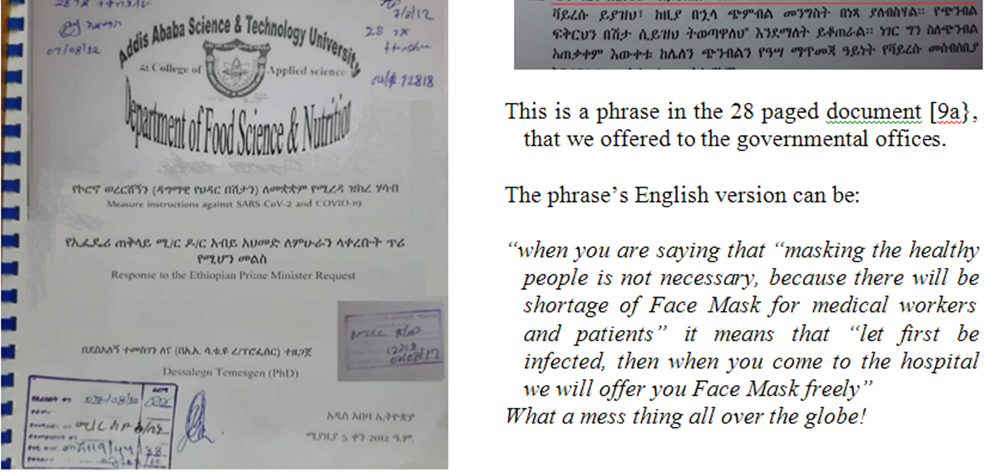
Picture 1: The cover page of a 28-page Proposal on COVID-19 protocol (a response to the Ethiopian PM request).
To be free from such pathogens, every assumption leads to the main options – to the two “DO NOTs”:
1.2.1.1 Do not contact (pass across) with the pathogen: don’t be there, where it is ought to be. For instance, avoid it by forbidding the infected to be around you. or
1.2.1.2 Do not let the pathogen to be around you (use effective defense mechanism)
Certainly, since, both directions are practicable, it is not easy to prioritize either. Particularly, if raises individuals’ right issue! Nevertheless, for us, the second option (1.2.1.2) – not to let the COVID-19’s virus – SARS-CoV-2 pathogen to be present around the possible victim is more attractive. Hence, if corona is absent, or if we can organize a self-fencing against it, then no snag at all. However,
1.2.2 To evaluate this half rational postulation, there are four theorems-arguments:
1.2.2.1 Do not let the coronavirus to be nearby – it is impossible, because already we have it;
1.2.2.2 Do not let the potential victim to come closer to it – impossible, because it is not visible, but contagious, mainly via atmospheric content – the air that we breathe;
1.2.2.3 Ignore it, because, after the death of those that are vulnerable to it or after many of us adopt a hard immunity (through local immune system [7]) the virus will disappear (may not have a host to continue reproducing); or
1.2.2.4 Intercept (shut) the path through which the pathogen can be transmitted/infects the host. This can be rephrased as – protect (shed-cover) the potential victim from being exposed to the virus.
Well, if we relate the 1.2.2.4 as a derivation from 1.2.1.2, then again the question “but, how?” is more than substantial. Therefore, if we can able to answer it properly, we can achieve a game changer result in fighting with such pathogen.
1.3 hypothesis
1.3.1 According to the above theorems (1.1.2 and 1.2.2.4), more preferable answer for our postulation is – not to let the virus to enter into our respiratory tracts [5,6,8]. In particular, by partially covering-closing the three openings-cavities: the two nostrils’ and oral’s cavities
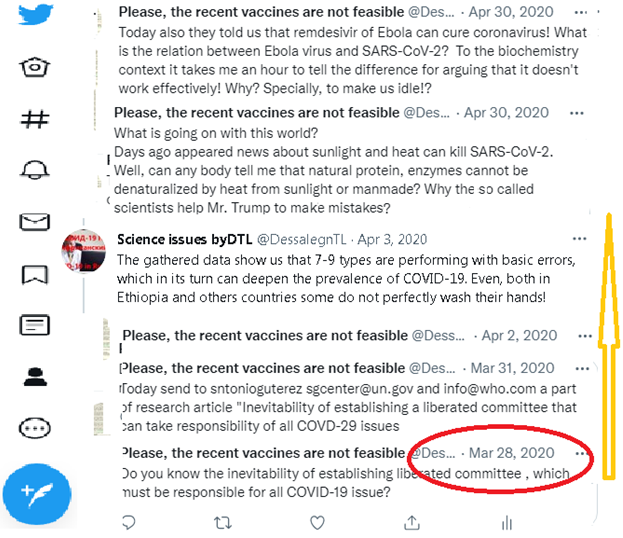
1.3.2 Certainly, since the virus enter into our respiratory tracts through nostrils’ and oral cavities, covering/sheltering these cavities from contacting with the virus is the decisive measure and serves as our hypothesis “effective-feasible measure to stop the COVID-19’s pandemic”: are stay at safe place (SaSP) and if forced to go out never wear off Face Mask (NOFF) until return back. As seen in the twit 1, since April 2021, this hypothesis has been conceived and grown in our mind, as a result which we tried to enclose it into the 6th our published manuscript [8]. However, not to make the manuscript bulky (it contains 3 separate articles (information)) and to have more attention by publishing it separately, we launched this 7th study that focuses only on SaSP and NOFF. Earlier, we tried to give a clue for stakeholders by publishing manuscripts [4,5]. For instance, the following pie chart 2, was designed on April 2020 naming as – ‘the secret of success against COVID-19’ (refer to pie chart 1):
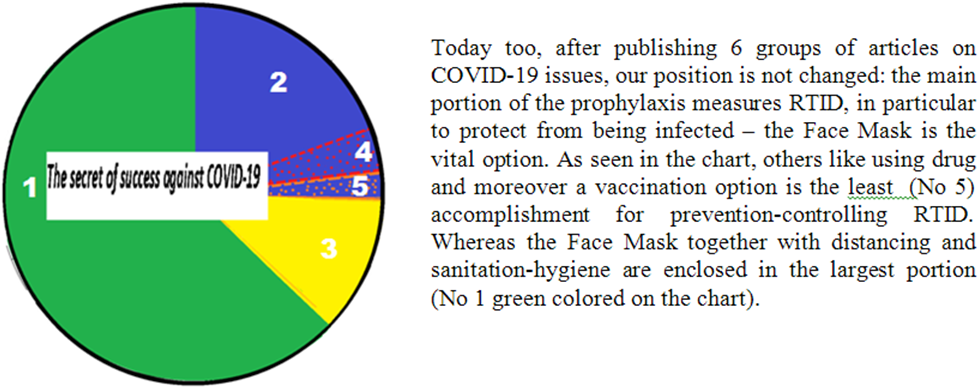
Chart 1: Control-prevention measures and their proportion to stop the pandemic.
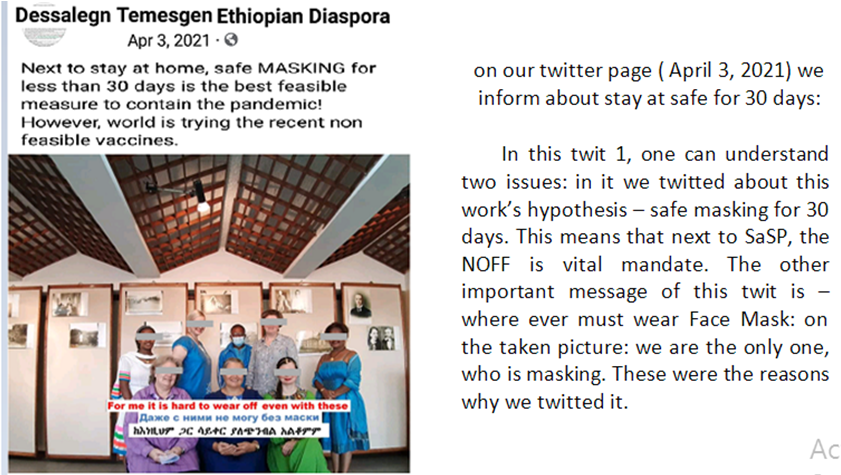
Twit 1: we twitted on April 3, 2021 an event with foreigners.
We launched this 7th study to justify the vigorous roles of SaSP and NOFF to stop RTIDs pandemics, because, in additional to the content mentioned above (1.2):
1.4.1 To re alert world that no stakeholder, even our university doesn’t consider our earlier works [5,6,8,9], in which we have postulated the easiest, fastest, and cheapest, but feasible-effective measures to stop not only the current pandemic (refer to our twit from April 3, 2021), but also to minimize (if not abolish) others airborne/air droplet respiratory based pathogens is the SaSP and NOFF mandates. Not only through publication, but also using own Face Book-Twitter pages, tried to alert the globe about Face Mask’s advantages, deliberately (at least due to pharm business); lack of understanding the nature of COVID-19; and lack of awareness about the exceptionality of human respirator’s tissue, the accountable bodies do not properly-firmly aware their nations about this vital safeguard (Face Mask) against respiratory based pathogens! As a result, which in this 21st century, when civilization is trying to conquer the universe, this pandemic is crumbling lives as an autumn leaves;
1.4.2 Today’s science-based articles are oriented only for specialists; because of which public cannot easily retrieve actual information. Therefore, to publish public oriented article; and
1.4.3 To reveal the vitality of SaSP and NOFF, through publishing a separate article about their nature-characteristics and role. Although, we are poor in epidemiology-oriented study, will implement a survey (primary data) and epidemiology based secondary data analysis, to:
1.4.3.1 indirectly justify the hypothesis (1.3) that because of Face Masking, comparing to the past 3-5 years (2019 and before it – using them as a control), influenza and lung tuberculosis (TB) like RTIDs decreased during the pandemic’s years;
1.4.3.2 We will try to forecast when and how long to implement the SaSP-NOFF mandates campaign, to stop not only this pandemic, but also at least to minimize others RTID like: flu-influenza and lung TB.
2.2 Comparing the burden of RTID before (at least 5 years data on prevalence) and during the 2020 and 2021 2.3 Reviewing Face Mask related literatures
2.4 Determining how long is possible the “SaSP and or NOFF” campaign
3.1.1. Recording (picturing) on the street and indoor events – a primary data.
To evaluate how far is accurate the public’s awareness on Face Mask usage, we will analyze what we have observed (during pandemic’s two years) on the streets and indoor events (meetings conferences, etc.)
Tools: audio-video recorder camera and internet as well.
Tools: we are going to implement three questions (in Amharic language):
3.1.2.3 ?????????????????????????????????????????????????30 ???????????????????????? ????
Its English version may have the following sense: What do you think, can influenza, TB, COVID-19 and others infections that are transmitted through air droplets/air borne will be disappeared if the whole world agrees to stay at home for 30 days? Why?
Burden-incidence of influenza, TB, etc., like RTID during the 5-7 years (as controls) and during the 2020 and 2021 (experimental data)
3.2.1 prevalence (burden) of influenza like RTID within Ethiopia
3.2.2 In others geographical regions: North hemisphere (Canada, USA, and UK, South Korea); tropical (Argentina, Kenya, Australia); and Southern hemisphere (South Africa)
3.2.2.1 Secondary data on prevalence of RTID will be collected from the following sources: Addis Ababa health centers; city’s health office bureau; and ministry of health (its data will represent the whole country’s burden)
Except Ethiopia, others countries from which we are going to take sample data of the prevalence of influenza like RTID should be 3-5 countries, that are located in 3 different hemispheres (north, south and tropic)
| Pathogen | Common symptoms | Clinical complications | 2017 | 2018 | 2019 | 2020 | 2021 |
| Rhinovirus | Rhinorrhea, coryza, sneezing, sore throat, cough | Asymptomatic, mild to moderate upper-respiratory tract illness, bronchitis | |||||
| Adenovirus | Fever, rhinorrhea, coryza, sneezing, sore throat, cough, pink eye, diarrhea, bladder infections | Mild to moderate upper-respiratory tract illness, croup, tonsilitis | |||||
| Seasonal influenza | Fever, rhinorrhea or stuffy nose, coryza, sore throat, cough, headache, myalgia | Mild to moderate upper-respiratory tract illness, bronchitis, croup | |||||
| RSV | Fever, rhinorrhea, coryza, sore throat, cough, wheezing, shortness of breath | Mild to moderate upper-respiratory tract illness, bronchitis, bronchiolitis, croup | |||||
| Enterovirus D68 | Rhinorrhea, sneezing, cough, mouth blisters, myalgia; wheezing and dyspnea in more severe cases | Mild to moderate upper-respiratory tract illness, bronchitis, bronchiolitis, pneumonia | |||||
| Pandemic influenza | Fever, coryza, rhinorrhea or stuffy nose, sore throat, cough, headache, shortness of breath, dyspnea, myalgia | Bronchitis, croup, pneumonia, diffuse alveolar damage, acute respiratory distress syndrome, respiratory failure | |||||
| Tuberculoses | |||||||
| Others | |||||||
| If no data for each year, then in general – all respiratory based infections (except COVID-19) | |||||||
| Any other suggestion (if any) | |||||||
Table 1: A form’s content that we will attached for our mentioned above data’s sources to fill it.
3.3 Literature based secondary data on control-prevention measures against influenza, TB, COVID-19 RTIDs.
The literature-based data will target more often the Face Mask within the campaign of NOFF
3.3.1 The sanitation-hygiene, distancing and vaccination are said to be prophylaxis measures. However, for this work our focus is the Face Mask as the representative for NOFF. Therefore, during literature review, we are going to focus by dividing the data that we are going to collect at least into 4: 3.3.1.1 History-Development of the Face Mask; 3.3.1.2 Characteristics of Face Mask; 3.3.1.3 Types of Face Mask; 3.3.2.4 Structure of Face Mask; 3.3.1.5 Utilization of Face Mask
3.3.2 Draw backs of Face Mask
3.4 lock down
3.4.1 history of lockdown; 3.4.2 lock down during COVID-19 pandemic; 3.4.3 draw backs of lockdown measures
3.5 How to implement the SaSP and NOFF
3.5.1 How long lasts COVID-19 infection; 3.5.2 how long the infected can be active to infect others
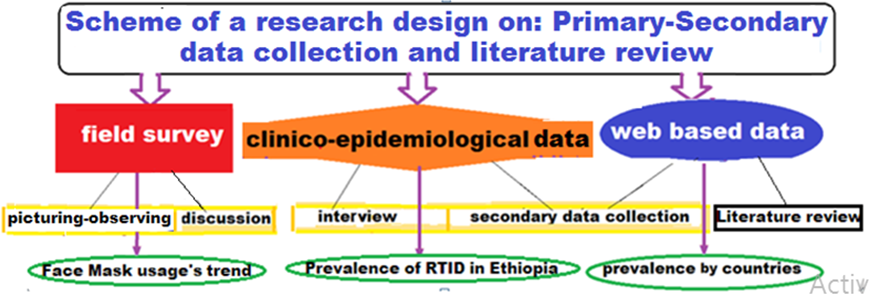
Based on line chart (refer to methodology), we arranged this research’s result into: field survey – picturing-recording activity to assess on how public uses Face Mask and discussion-interview during these pandemic years (primary data); secondary data collection (on the prevalence of RTID in Ethiopia and others three geographically in different locations); review literature on nature and role of Face Mask lockdown mandate (which may highlight for how long to use SaSP and NOFF for 30 days to stop wave of COVID-19 and others RTID as well.
4.1 Field survey (primary data): Observing and picturing to evaluate public’s awareness on Face Mask’s utilization.
4.1.1 Observing and recording (picturing) on the street and indoor events – a primary data
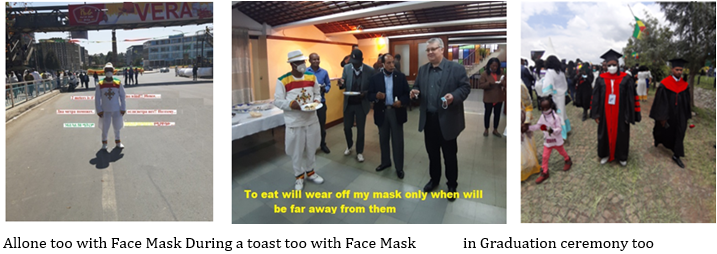
To evaluate how far the public uses Face Mask within the last two pandemic’s years (2020 and 2021), periodically we recorded-pictured on the street the public’s behavior – (how far public takes the distance keeping and Face Masking prophylaxis options). However, for convenience (not to make the manuscript bulky and to pay less publication fee), we selected pictures of only 3 intervals of the years (April, August, November-December) of both 2020 and 2021).
As a tool we used mobile for audio-video records
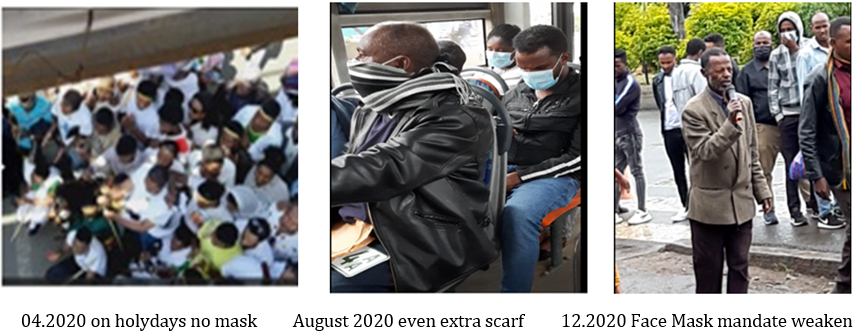
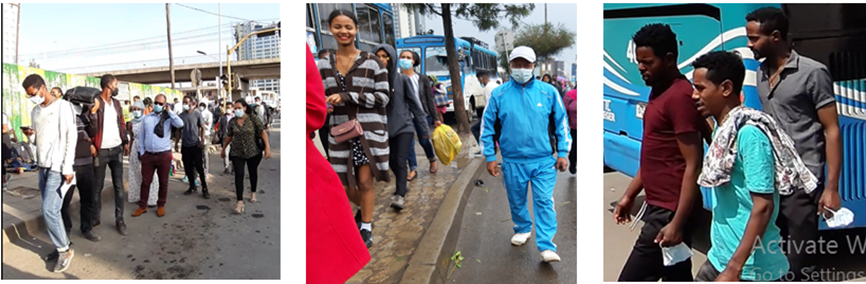
The above 6 photos have been selected from April, August, and November-December pandemic’s years collections.
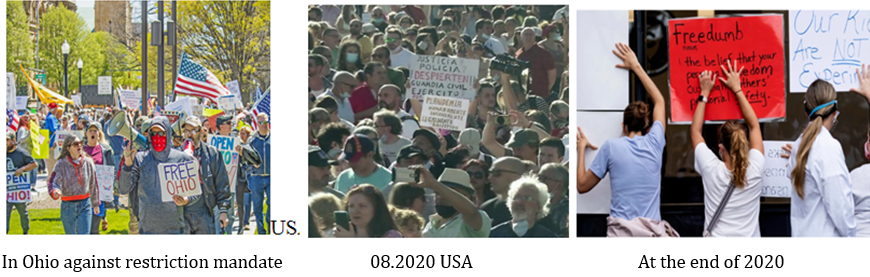
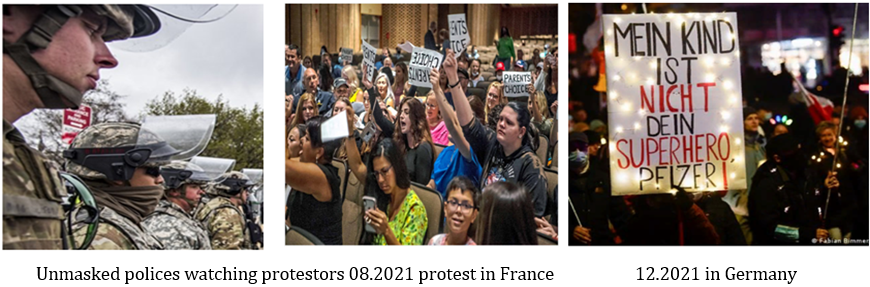
What was the the situation in other countries? There, comparatively the situation is worsening. As seen in both of the two pandemic’s years against lock dawn, Face Mask and vaccination mandate rises (refer to table 4). Moreover, [15] wrote that COVID-19 Is fueling Unrest in the US in demonstrations. In demonstration-protest, the public is said to be without Face Mask.
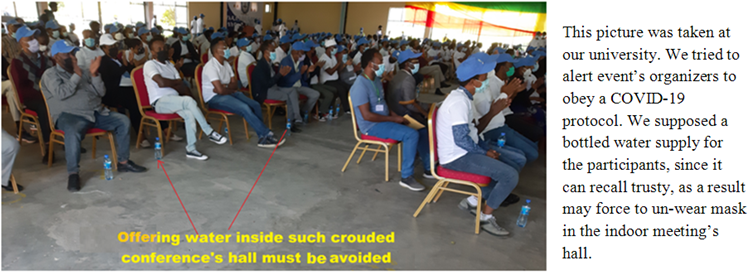
The other type of our survey study was observing and recording indoor events: Participants, that more or less are from educated part of a society, do not follow the Face Mask mandate. It is accustomed to drink in such crowded halls. Moreover, on the issue, we ourselves have had a conflict within own university’s officials;
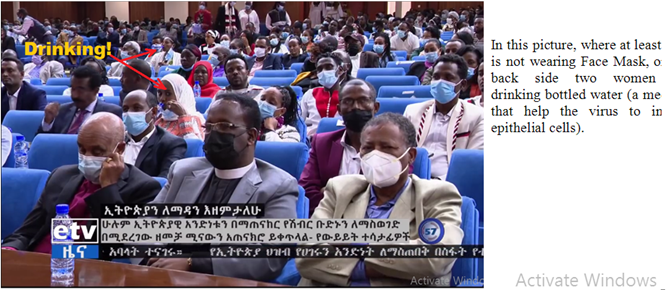

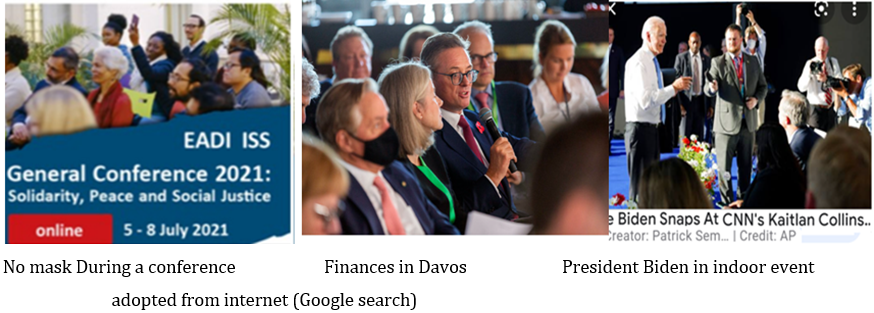
Picture 4: To illustrate that politicians and religious leaders try to avoid Face Mask during speech delivery.
In indoors, there is less surface and air movement. Therefore, probability to be infected in such place is high. Nevertheless, in hotels and others events speakers even do not Face Masking.
4.1.1.5 Posters and Ads: pictures from posters (instruction) against COVID-19 issues, at Addis Ababa (Ethiopia)
Posters are engines for any businesses, for which they are intended to give information about. Therefore, regarding to COVID-19 too, as a prophylaxis option, posters can play vital role in making awareness among the public [4]. However, their details should be approved by specialists.
See what kind posters are running: as seen in the following selected (table 7) they are harmful rather than giving positive impacts in fighting against the pandemic.
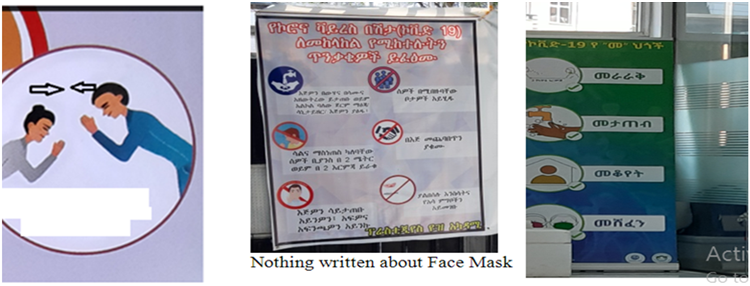
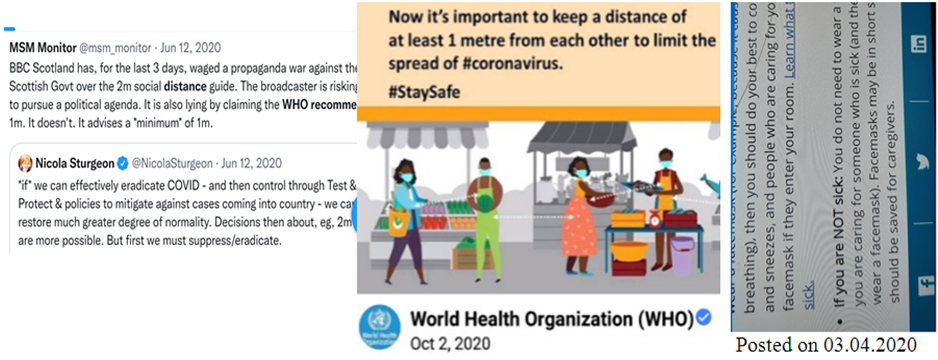
Here under, regarding to prophylaxis measures, illustrated posters that have been prepared and twitted by WHO
The discussion-interview part was held with the public and health workers respectively:
Tools: as an instrument (tool), we used the above mentioned (3.1.3.1 and 3.1.3.2) two questions
To our observation, starting in the middle of 2020 and ending at the middle of 2021 (4.1.2) at least in the public transport, everyone was using Face Mask. However, today at the end of November 2021, we have recorded a video on the crowded street. Within 3.1 minutes, from first 100 that we fixed 63% were wearing Face Mask!
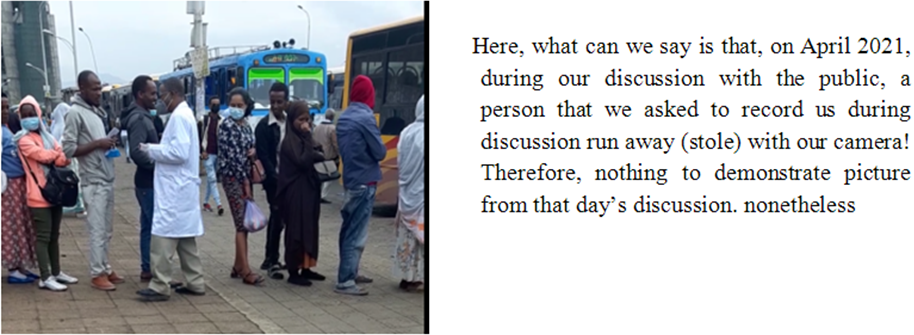
For the first our question-based discussion (refer to point 3.1.2.1 and 3.1.2.2): Why, almost for a year and half, I have no flu, what is the reason behind? And why we must use face mask?
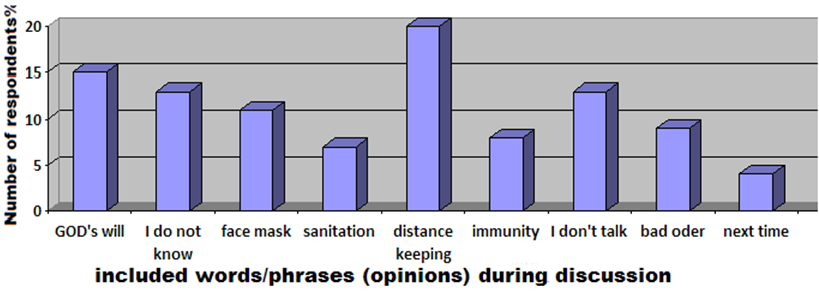
From the first 100 respondents (random method [17,18]) on the street (from April – November 2021), 15 respondents wishes me not to be infected further (connecting with God’s willing); 17 answer – they do not know, with expression of non-willingness to have a conversation with me; 9 answered, because of face mask; 21, raised the hand washing issue; distancing raised by 6; 8 touched immunity issues; and 13 directly said that they do not want to deal with me on the issue; 7 respondents replied me in question form: maybe you didn’t exposed to bad odors?; and 4 promised to think over it to reply to me during our next meeting (their diplomatic refusal). After 6 months, for the same question, respondents add in their answer – a vaccination issue: they think that because of I have vaccinated against corona, I am not sick of influenza!
We have had a possibility to interview 22 medical workers (from 3 medical centers, Addis Ababa health bureau and Ethiopian Health Ministry). As a result: 3 of them do not want to discuss with me; 9 were related it with immune system, 3 related it directly to hygiene, whereas 7 directly believe that the face mask is the reason why I have no flu during the pandemic
Data collection on: influenza, TB like RTIDs of 2015-2019 and the two pandemic years (2020-2021).
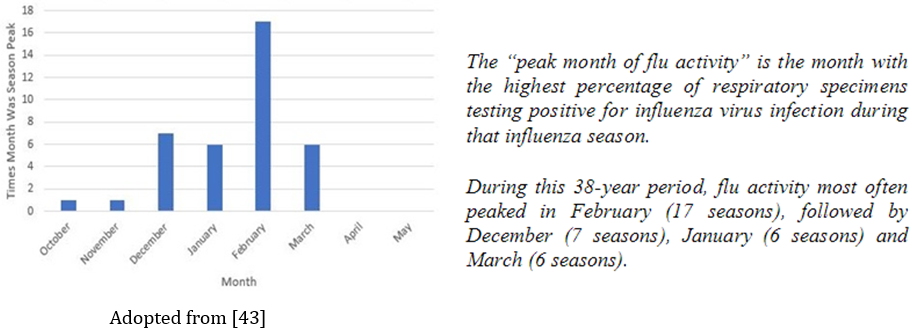
For this work not to make it bulky through listing 200 countries, we can just divide them into three categories: developed and developing, to holydays and production seasons, whereas, for geographical-climate issue, we can divide the globe into three: north, south hemispheres, and tropical regions. For this part the result of 4.2 mainly the graphs 2-5, can serve to determine the peak season for influenza like illness of the others RTID seasonal burden too. Additionally, in the CDC information [31]. This part of data will help us to decide – in which month and may be for how long is better to start the SaSP mandate throughout the whole globe at a time. Our data sources’ location were distributed as follows:
4.2.1 Tropical regions (Data that we collected within the tropical region Africa (Ethiopia- Kenya as tropicals),
4.2.2 North hemisphere (Canada, USA, UK) as northern hemisphere and in Asia (Malaysia and South Korea derivative of northern hemisphere)
4.2.3 Southern hemisphere South Africa, Australia, Argentina (as southern hemisphere)
4.2.1 Tropical regions
4.2.1.1 The secondary data on prevalence of RTID that we have collected from 3 Addis Ababa health centers; from the city’s health bureau and the data that we achieved from ministry of health may represent the country’s prevalence of influenza: Procedures, through which we passed for performing a secondary data collection from health centers – Having a supporting letter from our University, and then from Ethiopian Ministry of Health, we collected data from health services sights: health center; health bureau, and Ministry of health (refer to table 9).;
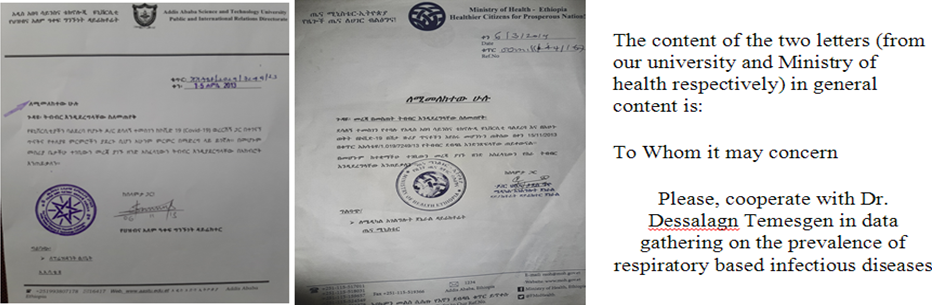
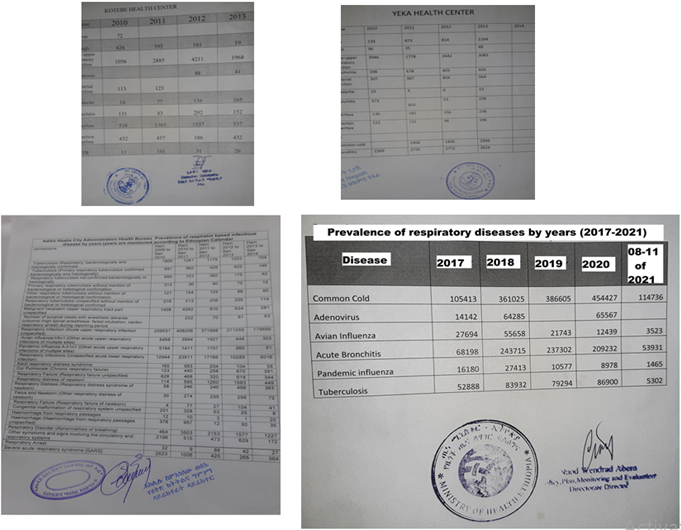
Table 10a, b.c.d: Data from 2 Health Centers, City Health bureau and Health Ministry.
Authors [2] stated the following: The World Health Organization (WHO) estimates that acute lower respiratory infections account for 4 million deaths per year. The rates are even higher in developing countries.
As seen in the graph {9], during six years of surveillance in Kenya, influenza was associated with nearly 10 percent of hospitalized SARI cases and one-sixth of outpatient ILI cases. Most influenza-associated SARI and ILI cases were in children
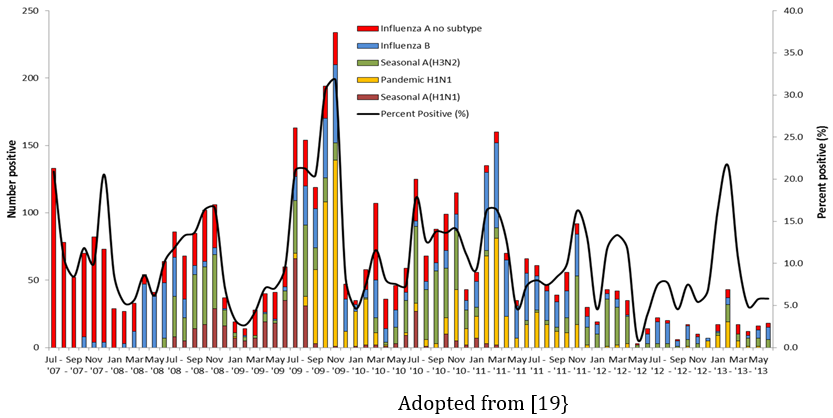
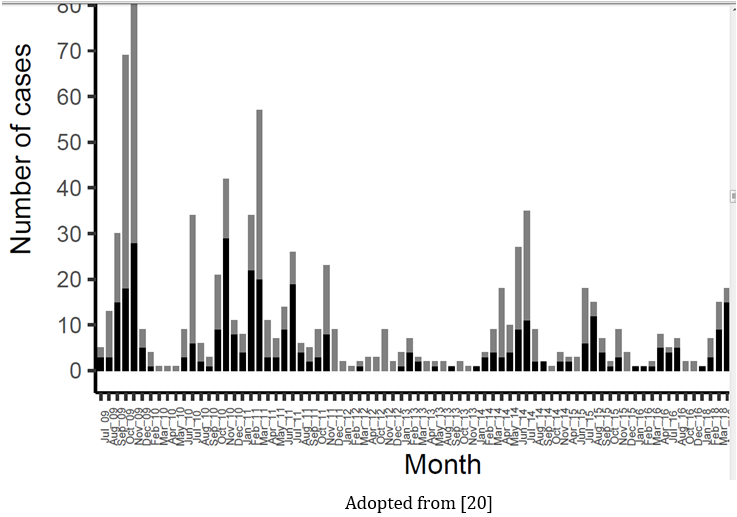
Data on influenza like RTID retrieved from South Africa: [21], while COVID-19 cases are surging in South Africa of the back of the dominant Delta variant, the flu virus has virtually vanished. [22] Facility-based surveillance revealed a decline in influenza virus detection during the regular season compared with control years. This happened throughout the implementation of COVID-19 control measures. [44] inform that because of taking basic measures like masking and school closure against coronavirus, flu eliminated in South Africa. [45]
4.2.3.1 temperate region: Data on influenza like RTID retrieved from South Korea
Estimating Influenza associated Mortality in Korea: The 2009-2016 Seasons shown in [23]. In the work [24] seasonal influenza-like illness in South Korea after 2- and 30-weeks using Google Trends, as seen in graph 4, before and after schools closed for quarantine.
4.2.3.2 data from UK,
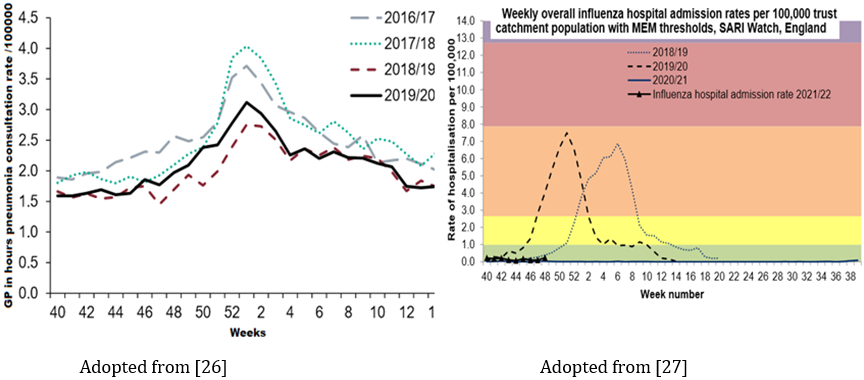
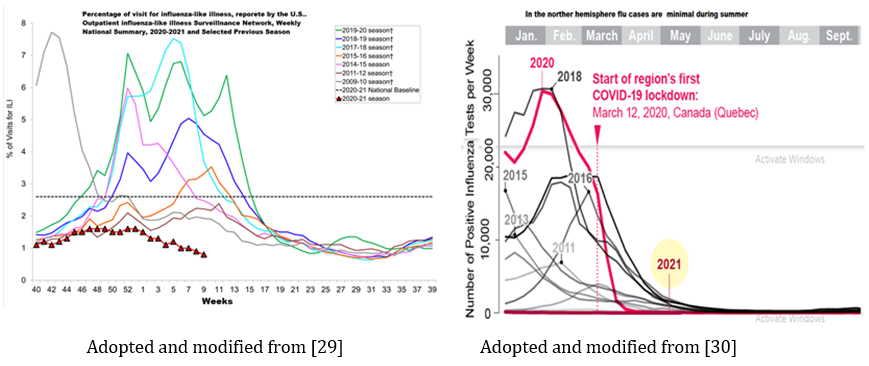
In the work [28] expressed that despite high levels of testing, flu activity was unusually low throughout the 2020-2021 flu season both in the United States and globally. The low level of flu activity during this past season contributed to dramatically fewer flu illnesses, hospitalizations, and deaths compared with previous flu seasons.
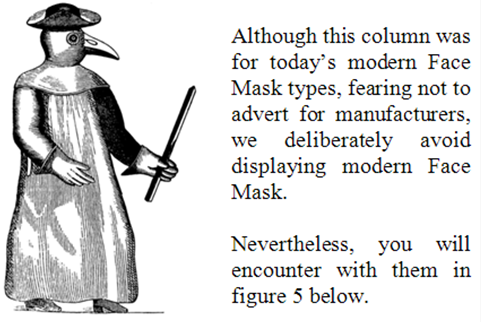
4.3.1.1 History-Development of the Face Mask
4.3.1.2 Nature (characteristics) and types of Face Mask
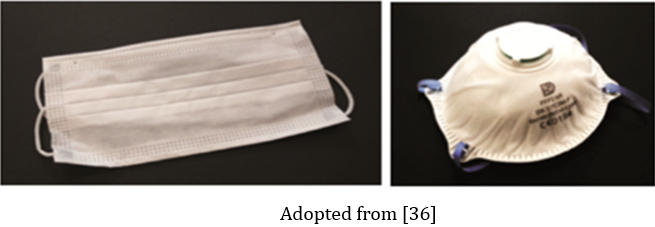
The nature and types of Face Mask depend up on their functions. Among them are for fireman, anti-poisonous gas [31], etc. to visualize, refer to table 11 below.
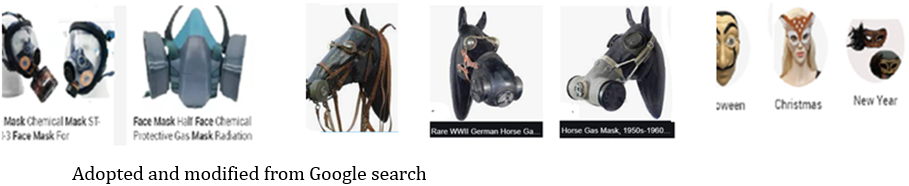
To the end user, various types of masks give diverse levels of protection. Today, most types of modern Face Masks are three layers, where the outer layer is mostly a hydrophobic (do not attract moisture) and some authors inform us that there are Face Masks that are statically charged [3,35]. [33] Spun-bonded polypropylene is a fabric or structure in the category of nonwoven textile … A mask used in a healthcare setting is a disposable face covering. Authors [34] – testing and comparing on surgical vs respirator masks: Surgical masks are typically made of nonwoven polypropylene fabric and mostly consist of three layers. The first and third layers generally spun bond, while the middle layer is melt-blown. This composition is commonly referred to as SMS technology. The density of the first and third layer is usually 20 gsm (gram per m²), while the middle layer is 25 gsm. The reason for using nonwoven fabric is mostly because of the higher air permeability, the higher bacterial filtration efficiency and the lower manufacturing cost compared to woven fabrics.
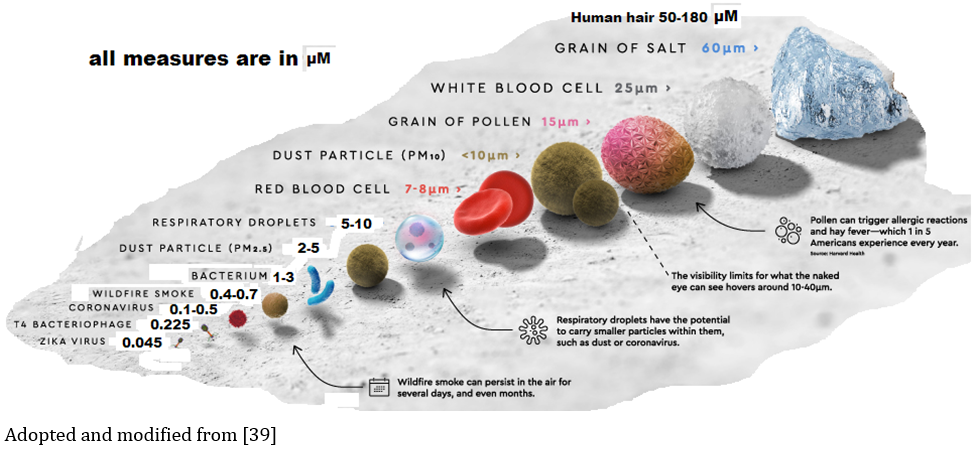
What we are breathing in (inhaling) contains? “Everything within the atmosphere” like gases, non-living and living things (refer to figure 2) – any, with less density than air and at least with a minimum air movement (not in a vacuum [5])!
Nitrogen, Water, Oxygen, Carbohydrate molecules and others atmospheric particle: The rough percentile content of the mentioned gases within the atmosphere is: N2 with a molecular weight 28, is the main gas content of the atmosphere with more than 78%, Gas O2 with a molecular weight of 32 has around 21% content of atmosphere. Gas Ar (an inert gas) around 39, with the atmospheric content of 0.93 and CO2 with a molecular weight of 44 has around 0.04% and H2O, which has a molecular weight of 18, its content varies based on the temperature and pressure as well as others contents of the atmosphere and may exceed up to 4%. In the work [38], researchers have also evaluated the size and content characteristics of the SARS-CoV-2 particles. Upon analysis of negative-stained SARS-CoV-2 particles by electron microscopy, different researchers have had varying results, for instance. the diameter of the virus has been found to range between 50 nm to 140 nm.
Certainly, this is our main issue, because we are talking about Face Mask that are necessary to filtrate pathogens from important gasses.
4.3.3 Importance of Face Mask to contain the pandemic and others RTIDs
4.3.3.1 General usage of Face Mask against pathogens
In principle, this part is the core of the study
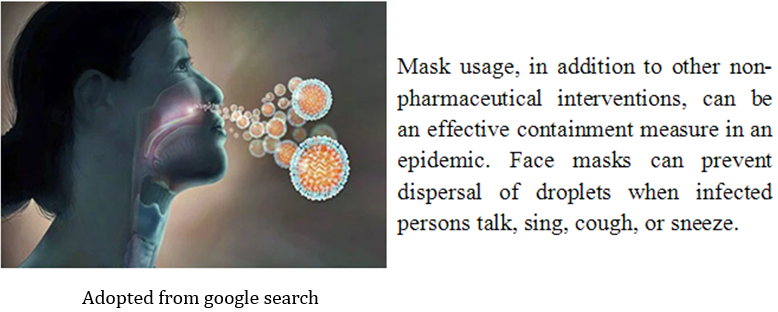
In [3] identified ways of transmitting the SARS-CoV-2: A respiratory pathogen may be transmitted via three routes—contact, droplet, and airborne spread. Masks and other PPE items serve as a physical barrier to respiratory droplets. With imaging using laser light scattering, it was found that the number of flashes, which corresponds to the number of respiratory droplets, could be kept at background levels by covering the speaker’s mouth with a slightly damp washcloth.
Yes, as seen in table 2-6, mask is not properly utilizing against COVID-19 pandemic:
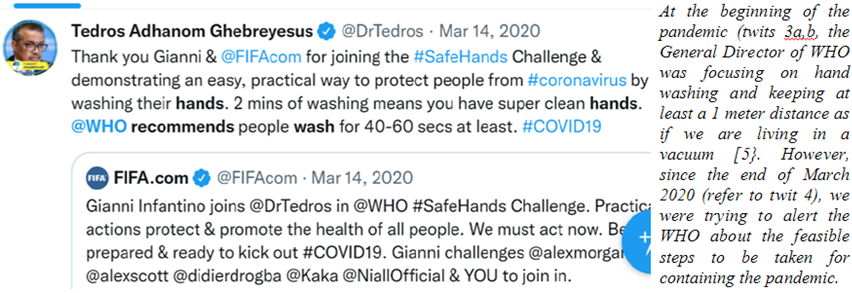
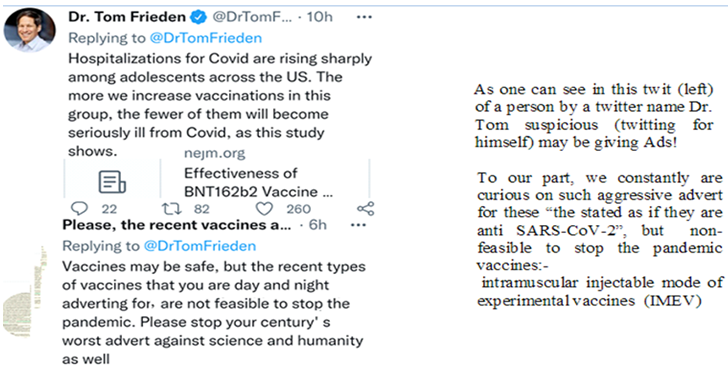
During the first quarter of 2020, there were misinformation (refer to twits 2 and 3) about distancing and even as if Face Mask is useless (twit 3c vs. picture 1)! for those that are yet not infected. This primary world’s stand was the main reason, why we begin to involve in the COVID-19 issues: After we tried to contact with WHO, CDC, Media, and others stakeholders (refer to twits 2 and 3 vs. 4). In April 2020, we prepared the 28 paged proposals on COVID-19 protocol (refer to picture 1) for the government of Ethiopia. Furthermore, have had applied to the country’s amnesty office with attaching the mentioned proposal [9a]. Although, not strongly-firmly, the CDC, WHO and others responsible bodies too, now a days start to introduce about the Face Mask usage through social media. Authors [35] stated that A growing body of evidence supports the idea that wearing face masks in public, even when you feel well, can help curb the spread of the coronavirus. Authors [41] by adding that Mask wearing, social distancing, and other steps to stop COVID-19 have also curtailed influenza.
Of course, Face Mask is necessary not to let respiratory based pathogens into our oral and nostrils’ cavities.
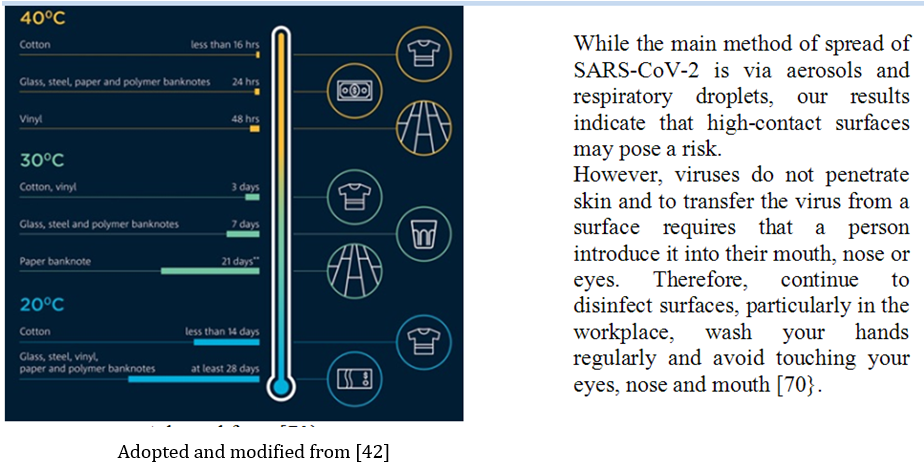
Where and how long can survive SARS-CoV-2?
4.3.4.1 Although, we are not satisfied in their data formation, among literature (secondary data) that we have encountered about seasonal influenza burden-surveillance, the USA CDC and of England can be said to be better organized-harmonized system about seasonal influenza like illness surveillance than others (graph 2-4).
We have seen the influenza like illness during the COVID-19 and before it. Since lung TB too is a type of RTIDs, we can use it for comparison about the broad role of Face Mask:
Seasonal patterns of COVID-19 incidence and Influenza-Like Illnesses incidence are highly similar. Specifically, there where is less temperature and radiation [46,47]
Certainly, for any positive side always there should be opposite part: The ongoing COVID-19 pandemic has even resulted in a global shortage of face masks and the raw materials that go into them, driving individuals to self-produce masks from household items [3].
Covering face against smiling; problem to talk-hear; reading from lips movement for those not hearing; extra expense, its usage for criminal purposes, etc. what about the technical, economical, and social impacts?
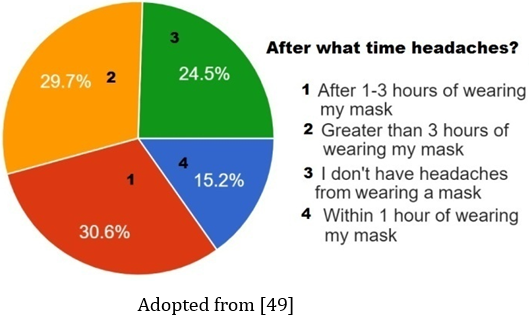
At the end of April, 2020, when about the role of Face Mask, we prepared a document to the government [9a] (refer to picture 1) in it we expressed our arguments against the world, which emphasized distance keeping and hand washing [5] and refer to twit 2 and 3. Because, at that time mass masking was considered as if criminals can use the situation and there will be shortage of it for health workers. In the work [49] inform us that prolonged use of N95 and surgical masks by healthcare professionals during COVID-19 has caused adverse effects such as headaches, rash, acne, skin breakdown, and impaired cognition in the majority of those surveyed. [49] point out is harder to breathe, to hear the person you are talking
If in the above 4.3 and 4.4 of the literature review parts were about Face Mask’s: nature, types, internal structure; its main role against respiratory based pathogens; and drawbacks. Then, here we will pass through on literature givens about the COVID-19’s pathogens transmission paths.
Here, if we agree on the lingo “infection” to the given context is an action: when the endocytosis process (crossing the epithelial cell membrane and enter into the cytoplasm) by the SARS-CoV-2 takes place for further reproducing several virions, then the way of infection can be expressed as – invading the epithelial cells of respiratory tracts by the virus SARS-CoV-2 that enter through the nostrils’ and or oral cavities.
According to [50], to fight a pandemic-dates back to the Byzantine Emperor Justinian, he imposed isolation for both travelers and food coming to Constantinople from North Africa, hit by the terrible plague outbreak (541-542 A.D).
The table 4 and 5 of protestors above, indicate that due to the fault of responsible-regulator bodies (they didn’t well clarify the history, nature, advantage-disadvantage of the lockdown, nations resist it. Although, 18 months ago [4], we tried to point out the necessary, still now no structured documents (except of some individual countries protocols) from at least responsible bodies like CDC and WHO about the whole lockdown processes we have found out.
In the work [51], the advent of pandemics in the history of humankind has always been accompanied by a series of social, political and economic measures. In 412 BC, Greek physician Hippocrates reported an epidemic that modern doctors believe was the first recorded reference of influenza. Subsequently, there were two major plague pandemics in Europe—the Plague of Justinian (from 600 AD) and the Black Death (from 1340s onward)—followed by socio-political and economic consequences. Authors [52], in their turn recommend that Government and management of cities should provide mobile clinic for pregnant and patients at house to house. This will help to prevent unforeseen deaths of pregnant women and patients with underlining sickness.
The survey on public’s awareness and manner of utilization a Face Mask
Into COVID-19 study, we switched during the early March of 2020. Since then we are observing; recording-documenting; and discussing with the public at Addis Ababa city and with the globe at large also through internet-social media. As a result, we are author of 6 published manuscripts [4-8] on the pandemic’s issues. We have a collection of audio-video and photographs that are taken on the street of Addis Ababa and others countries’ (retrieved through websites) demonstration and protests against COVID-19 related restrictions like lockdown and Face Mask wearing mandates. Totally, we have a softcopy with a volume of around 100GB data that relates to the pandemic. However, for this work, aiming not to make it bulky, and to minimize publication fee too, we selected only quarters (April; August; December; for 2020 and November for the 2021).
As we indicated in 1.4, we gathered data on burden-surveillance of influenza and TB like RTIDs before and during the pandemic years. Because, we aimed to show whether the distance and Face Mask mandates together with the lockdown decreased not only the COVID-19 (although, within only two years data impossible to have a strong conclusion), but also others RTIDs. The results that shown in graphs 2-5, directly confirmed that the prevalence of influenza and TB like illness, before the pandemic was higher than today. Furthermore, according the graphs 5 and 6 even we can suggest that others RTIDs are in zero level during the pandemic, because of restrictions. However, data on surveillance of illness in different countries is not identically gathered. Because, of which we couldn’t achieved what we were designing in the methodology part (3)!
5.3.1 Face Mask related mandates
For the public, the history of Face Mask indicated in 4.3.1 can be attractive to have positive attitude to Face Mask. Next to giving awareness about the Face Mask’s nature, types, internal structure and usage, the other attractive issue for the public can be the relative size of contents of the atmosphere that we breathe in and showing how Face Mask selectively permit only atmospheric gases to be inhale. Certainly, the gathered information can alert-caution the public that not all masks capable to filtrate pathogens.
How one can understand the world lockdown? It seems that like others words, the “lockdown” joined from “lock” and “down” Being away from the possible address, where may be present/exist the virus SARS-CoV-2
During the March-May of 2020, almost throughout the world, there were front lines to a lockdown mandates. However, as in the case of Face Mask, everywhere was anti restriction, because authorities didn’t prepare the public for such effective prophylaxis measure. Even, we ourselves became more interested to such mandate after we gathered data on its history. If that so, neglecting the ancient pandemic, we were ought not to forget yesterday’s: Ebola; SARS; the Chernobyl and Japanese’s lockdown against the atomic reactors’ catastrophe, that we have categorized in [4] as industrial (civilization born) disaster.
6.1 During the pandemic years, burden of others RTIDs decreases. Because, among others prophylaxis measures, more or less we are using the Face Mask. However, we revealed that unwittingly or intentionally, less effort is doing on awareness making about the Face Mask’s vitality against respiratory based pathogens. Whereas, nations didn’t get their right to know the points mentioned in section 1.2.2.4 and 1.3.2 of this work
- ECDC / Factsheet about seasonal influenza / European Centre for Disease Prevention and Control / An agency of the European Union / http//www.euroserveillance.org.
- Duncan Mwangangi Matheka et al. Overview of influenza virus infections in Kenya: past, present and future. Pan African Medical Journal. 2013; 14:138.
- Ming Hui Chua, Weiren Cheng, Shermin Simin Goh et. al. Face Masks in the New COVID-19 Normal: Materials, Testing, and Perspectives / Review Article Open Access /Volume 2020 |Article ID 7286735.
- Dessalegn Temesgen Leye / Options to Enhance the Control-Prevention Measures’ Achievement in combating COVID-19’s Pandemic (Global Scientific Journal GSJ).
- Dessalegn Temesgen Leye / Disclosing faults; correcting them; and revealing others vital, but yet unnoticed preventable prophylactic measures that must be implemented in battling against covid-19’s pandemic (International Journal of Innovation Scientific Research and Review IJISRR).
- Dessalegn Temesgen Leye. (2021). Role of the Linkages between Mucus Secreting Intensity and age Differences for Being Infected by SARS-CoV-2 / EScienti?c Volume 3 Issue 1.
- Dessalegn Temesgen Leye. Uncertainties on recent vaccines’ feasibility against sars-cov-2; postulating new approaches on drug-vaccine development; and schematizing the possible options for investigating the origin of a pathogen (International Journal of Innovation Scientific Research and Review IJISRR / V.9. February Issue).
- Dessalegn Temesgen Leye / Three puzzling questions on covid-19: are recent vaccines feasible to stop the pandemic; what measures can boost a vaccination; and does corona affect sexual intimacy? / International Journal of Innovation Scientific Research and Review Vol. 03, Issue, 11, pp.2032-2053, November, 2021 Available online at http://www.journalijisr.com.
- Dessalegn Temesgen Leye. The mere six first options to be taken for successful combating the COVID-19 Pandemic / Precision Medicine, NURSING and Addiction Medicine.
- [9a] Dessalegn Temesgen Leye /April, 2020/ Document-proposal on Measures/Instructions against SARS-CoV-2 and COVID-19: Response to the Ethiopian Prime Minister’s Request (document). Ministry of Health reg. ?119/44
- Nemanja Jovancic / 5 Reaserch Design Types+Key Elements and Characterstics / https://www.leadquizzes.com/blog.
- Huiling Peng and Shyue-Ying Chiang. Action Research on College Students’ Learning Satisfaction of Incorporating Art Therapy and Spirituality into A Career Planning Course.
- Amy H. Newton, Amber Cardani, and Thomas J. Braciale. The host immune response in respiratory virus infection: balancing virus clearance and immunopathology / Semin Immunopathol. 2016; 38(4): 471–482.
- Brian D. Aevermann, Brett E. Pickett, Richard H. Scheuermann. (2014). A comprehensive collection of systems biology data characterizing the host response to viral infection. Sci. Data 1:140033 doi: 10.1038/sdata.2014.33.
- Kwang-Ha Yoo, Hae-Ryun Ahn , Jae-Kyoung Park, et. el. (2016). Burden of Respiratory Disease in Korea: An Observational Study on Allergic Rhinitis, Asthma, COPD, and Rhinosinusitis / Allergy Asthma Immunol Res. Nov; 8(6): 527–534.
- Roudabeh Kishi, Aaron Wolfson, Myung-Gyun Lim, Hampton Stall, and Sam Jones. (2021). A National Emergency: How COVID-19 Is Fueling Unrest in the US / jhkj A NATIONAL EMERGENCY: HOW COVID-19 IS FUELING UNREST IN THE US / The Armed Conflict Location & Event Data Project (ACLED).
- Dessalegn Temesgen Leye. The mere six first options to be taken for successful combat the COVID-19 pandemic / Book of Abstracts: Precision Medicine Virtual 2020/ https://www.magnuswebinars.com/precision-medicine-virtual/contact.
- JSTOR /book: 8 Data Collection
- Paul J. Lavrakas. Random Sampling – SAGE Research Methods / https://www.methods,sagepub.com .
- Mark A. Katz, Philip Muthoka, Gideon O. Emukule, et .al., Results From the First Six Years of National Sentinel Surveillance for Influenza in Kenya, July 2007–June 2013.
- Owuor, D.C.; de Laurent, Z.R.; Kikwai, G.K.; Mayieka, L.M.; Ochieng, M.; Müller, N.F.; Otieno, N.A.; Emukule, G.O.; Hunsperger, E.A.; Garten, R.; et al. Characterizing the Countrywide Epidemic Spread of In?uenza A(H1N1) pdm09 Virus in Kenyabetween 2009 and 2018. Viruses 2021, 13, 1956.
- Adele Baleta / In-depth: Why is there hardly any flu in SARS-CoV-2 this year? / https://www.spotlightnsp.co.za.cdn.ampproject.org.
- Stefano Tempia, Sibongile Walaza, Jinal N Bhima. Decline of influenza and respiratory syncytial virus detection in facility-based surveillance during the COVID-19 pandemic, South Africa, January to October 2020.
- Kwan Hong, Sangho Sohn, and Byung Chul Chun. (2019). Estimating Influenza-associated Mortality in Korea: The 2009-2016 Seasons / J Prev Med Public Health. Sep; 52(5): 308–315.
- Choi SB, Ahn I /Forecasting seasonal influenza-like illness in South Korea after 2- and 30-weeks using Google Trends and influenza data from Argentina. PLoS ONE 15(7): e0233855.
- Ji Yun Noh,Sooyeon Lim,Joon Young Song. et. al. (2017). Interim estimates of the effectiveness of the influenza vaccine against A(H3N2) influenza in adults in South Korea, 2016–2017 season/ PLoS One.; 12(5): e0178010.
- Surveillance of influenza and other respiratory viruses in the UK / Winter 2019 to 2020 / Public Health England.
- UK Health Security Agency / Weekly national Influenza and COVID-19 surveillance report Week 49 report (up to week 48 data) 9 December 2021 / Weekly National Influenza and COVID-19 Report: week 49 report (up to week 48 data).
- CDC / 2020-2021 Flu Season Summary / 2020-21 Flu Season Summary FAQ.
- FluView Summary ending on March 6, 2021 / FluView Summary ending on March 6, 2021_CDC.html.
- CDC / Influenza Season 2021-2022 | – Premier Safety Institute / https://www.premiersafetyinstitute.org › safety-topics-az.
- David Isaacs / Mask wearing: A historical, cultural and ethical perspective / Journal of Paediatrics and Child Health Volume 57, Issue 2 p. 176-177.
- National Academy of Sciences / Book: Reusability of Facemasks During an Influenza Pandemic: Facing the Flu (2006) / chapter 2 Characteristics of Respirators and Medical Masks.” Instiute of Medicine. 2006 / https://www.nap.edu/catalog/11637 / The National Academies Press.
- Medanta medical team / History and Evolution of Mask | Medanta Sep 3, 2020 / https://www.medanta.org › patient-education-blog ›.
- Porometer Document (Belgium) / Characterisation of Face Masks with The Poroluxtm 100 / Nieuwe Steenweg 20A – 9810 Nazareth – Belgium / www.porometer.com.
- Porometer Document (Belgium) / Characterisation of Face Masks with The Poroluxtm 100 / Nieuwe Steenweg 20A – 9810 Nazareth – Belgium / www.porometer.com.
- Cuffari, Benedette. (2022). “The Size of SARS-CoV-2 and its Implications”. News-Medical. 13 January 2022.
- Carmen Ang, Iman Ghosh, Harrison Schell. Zooming In: Visualizing the Relative Size of Particles / How coronavirus compares to the world’s smallest particles / / Zooming In_ Visualizing the Relative Size of Particles / https://www.weforum.org › 2020/10.
- WHO / 12.2021 / disease /Coronavirus disease (covid-19) advice for the public: when and how to use masks / all about masks in the context of COVID-19.
- Katie Peek / Flu Has Disappeared for More Than a Year / April 29, 20211.
- CSIARO / How long the virus can survive / www.csiro.au / research/disease/covid-19-research.
- CDC / Flu Season _ CDC / https://www.cdc.gov/flu/about/season/flu-season.htm#anchor_1531424547919.
- Z. Gashu, D. Jerene, D. G. Datiko, H. Hiruy, et. al. (2018). Seasonal patterns of tuberculosis case notification in the Tropics of Africa: a Six-yaer trend analysis in Ethiopia / PLOS One 13(11): e0207552.
- Tanja Charles, Mathias Eckardt, Basel Karo, et. al. (2021). Seasonality in extra-pulmonary tuberculosis notifications in Germany 2004-2014 – a time series analysis / BMC Public Health 21 ,661.
- Martijn J Hoogeveen, and Ellen K Hoogeveen. (2021). Comparable seasonal pattern for COVID-19 and flu-like illnesses One Health 100277.
- G. L. Nichols, E. L. Gillingham, H. L. Macintyre, et. al. (2021). Coronavirus seasonality, respiratory infections and weather.
- VJohn L.Spooner . (1967). History of Surgical Face Masks: The myths, the masks, and the men and women behind them / AORN Journal olume 5, Issue 1, January, Pages 76-80. 2092(08)71359-0.
- Eugenia Tognotti / Past the Virus – Containing Pandemics Throughout History / @9 June, 2021 / https://www.institutmontaigne.org.
- Ramin Jahanbegloo / Life lessons from the history of lockdowns / www.livemint.com / news/india.
- Wahab Musah-Abdul*, John Amoah-Nuamah, Lord Ebow Sampson/ Assessing the Effects of COVID-19 Pandemic Partial Lockdown of Cities on Access to Social Facilities / Volume 8, Issue 6, June 2020 Edition – GSJ Journal Publication.